tháng 5 2017


With the rising popularity of one of the most mysterious country in South East Asia, many people around the world are wondering: Where is Burma?


Burma, or Myanmar, officially the Republic of the Union of Myanmar, is the largest country in mainland Southeast Asia. It’s located at the northeast edge of Southeast Asia and borders Thailand, Laos, China, Tibet, India, and Bangladesh.
Burma has beautiful scenery and 1,200 miles of coastline along the Andaman Sea and Bay of Bengal, however, tourism numbers are far lower than those of neighboring Thailand and Laos.
The country was mostly closed off until relatively recently; the regime in charge didn’t do much to attract visitors. Today, tourists are flocking to Burma for one simple reason: it’s changing rapidly.
Although Burma is considered by some to be part of South Asia (the many influences from proximity can be seen), it is officially a member of ASEAN (Association of Southeast Asian Nations).

Burma or Myanmar?

Burma government officially changed the name to “The Republic of the Union Myanmar” by the ruling military junta in 1089. The change was rejected by many world governments due to the junta’s messy history of civil war and human rights violations.
Although diplomats and governments once showed disapproval by sticking to the old name of Burma, that has changed. The 2015 elections and the victory of Aung San Suu Kyi’s party helped open up international relations and tourism, making the name “Myanmar” more acceptable.
People from Myanmar are still referred to as “Burmese”.

Interesting Facts about Burma

Despite a landmass of 261,227 square miles, the 2014 census found a population of only around 51 million.
The capital of Burma was moved from Yangon (formerly Rangoon) to Naypyidaw in 2005. Yangon is still the largest city.
The mountains in Burma are home to many precious stones. Around 90 percent of the world’s rubies come from Burma. Sapphires and jade are also abundant. Some large Western retailers balk at gems from Burma due to labor conditions.
Burma was one of only three countries in the world (including the United States and Liberia) who had not yet adopted the metric system of measurement. In October 2013, the Burmese government announced that they were planning to migrate to the metric system.
Burma once had one of the strictest internet censorship policies in the world. Bloggers have been jailed for posting photos that depict problems in the country. Internet cafes would once hold onto your passport as they monitored your web usage.
Until 2013, Burma was one of only three countries in the world where you couldn’t buy a Coca-Cola; Cuba and North Korea were the other two. Now that Cuba is opening up, North Korea is the last holdout.
Burma is the second largest exporter of opium in the world (Afghanistan is the first).
The trains in Burma bounce and sway slowly along old colonial tracks. They cautiously cross the hair-raising Gorteik Viaduct. At 335 feet high, it is one of the highest railway trestles in the world.
Although international flights to Burma seems difficult nowadays, this country still worth a holiday.

How can you say: What time is it in Myanmar? One of the most effective way to get to know local people in a country is to share a common language. Sometimes you just need a friendly smile. However, if you can learn some basic phrases, you will not only have an easier time getting around but you will also get a warmer response from the people. In Myanmar, most locals know a bit of English but being able to utter some phrases in Burmese is always well received. Here are some phrases that can be useful when you travel to Myanmar.

Hello – Mingalabar

This phrase is pronounced “Min-ga-la-ba”. Literally translated, ‘Mingalarbar’ means ‘it’s a blessing’ and is the first word used to greet a person- local or foreign! As you know, the first contact is always very important so a warm “hello” or ‘Mingalarabar’ guarantees a friendly reception.

Thank you - Ce-zu tin-ba-deh

This phrase is pronounced “Dje-zu-te-mah-dae”. The simple ‘thank you’ always goes a long way! However, do not be demotivated by its lengthy sentence. There are some variations such as “Dje-zu-bae”. Do not hesitate to use it since it is not rude and very common. When you are in a formal situation, you should add a speaker pronounce to the end: Shin for ladies or kamya for men (ie- “Dje-zu-te-ma-le-shin” (for women) and “Dje-zu-te-male-kamya” (for men). If this is all a bit too much, simply use ‘No worries’- Ya Ba De

Nice to meet you – Twe-ya-dawun-tha-ba-deh

A bit more difficult to remember…or to pronounce! Your pronunciation may cause some laughter, but your efforts will always be greeted with grateful smiles.

How much? - beh lauq leh

This sentence is pronounced “bae lawt lae”. It is nice to be able to ask it in Myanmar language, but it is even better to understand the answer! Combine the following numbers with ya – hundred and taung – thousand to bargain without fear of losing face.: 1 (te), 2 (hne), 3 (tho), 4 (le), 5 (nga), 6 (chauk), 7 (kun hnint), 8 (chi), 9 (koh), 10 (tese) (for example: 1 000 = “taung” and 2500 = “hna taung, nga ya”).

The bill, please! – Shi-mae

This phrase, contrary to some countries, will never be a source of unpleasant surprise! Of course, if you cannot remember you can always use the ‘international sign language’ of pretending to sign a paper in the air.

Excuse me – Ta-sait-lout

It is pronounced “Tae-sae-lo”. Now that you catch their attention, the hardest part is getting them to understand what you want! The next phrase will probably come on handy…
Note: if you mean to apologize, you will then say “sorry sorry”. It is important to say it twice as saying “sorry” only once can be considered as rude and you do not want them to be more upset!

Do you have….? – Shie la.


Burmese language puts the words ‘have’ after the noun. So if you want fried rice, instead of saying ‘Do you have fried rice’, you would say ‘htamin kyaw shie la?’ It is more than probable though that you will point at something on the menu and they will tell you “Mashibu” which literally means ‘no have’.

You may not always get a menu if you sit at a beer station. Here are some helpful words to make sure you won’t starve: rice = hta-min; noodle = khout-swel (pronounced “ko-swe”), water = ye, beer = beer (that one is easy!), tea = lahpet-yeh (pronounced “lae-pe ye”).
You are now ready to delve in to the local culture and enjoy your holiday in Myanmar!

Myanmar was known as Burma until 1989. The country’s name was officially changed by the military government that took over in 1988. Early civilization in Myanmar dates back to the 1st century with archaeological evidences of the Pyu Kingdoms of Thayekhittaya (Sri Ksetra), Beithano (Visnu), and Hanlin. The Myanmar music (or Burma) has similarities with many other musical traditions in the region, including Chinese music and Thai music, probably because its longest land border is shared with China.

The Hsaing Waing is Myanmar’s traditional folk music ensemble. It is made up mainly of different gongs and drums as well as other instruments depending on the nature of the performance.

hsaing waing

Myanmar’s musical instruments are categorized into two types, the loud sounding and soft sounding. The loud sounding instruments are performed in open-air ensembles at ceremonies and festivals. Most of the hsaing waing instruments belong to the loud sounding category.

OTHER INSTRUMENTS IN THE HSAING WAING ARE THE:

HNE (A DOUBLE REED PIPE)
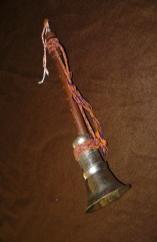
The Hne has a sextuple reed (called hnegan), made from the young leaf of the toddy palm, which is soaked for six months. The body of the Hne is made of wood, with a conical bore and seven finger holes at the front, set in a straight line, with a bell hung at the top. It has a flaring metal bell and has a loud tone, and is used in an ensemble together with xylophone, tuned gongs, and tuned drums
http://www.istov.de/pics/myanmar/hne.JPG
Maung HSAING
It is a larger bronze gongs in a rectangular frame


Image result for MAUNG HSAING myanmar
ALSO WAING
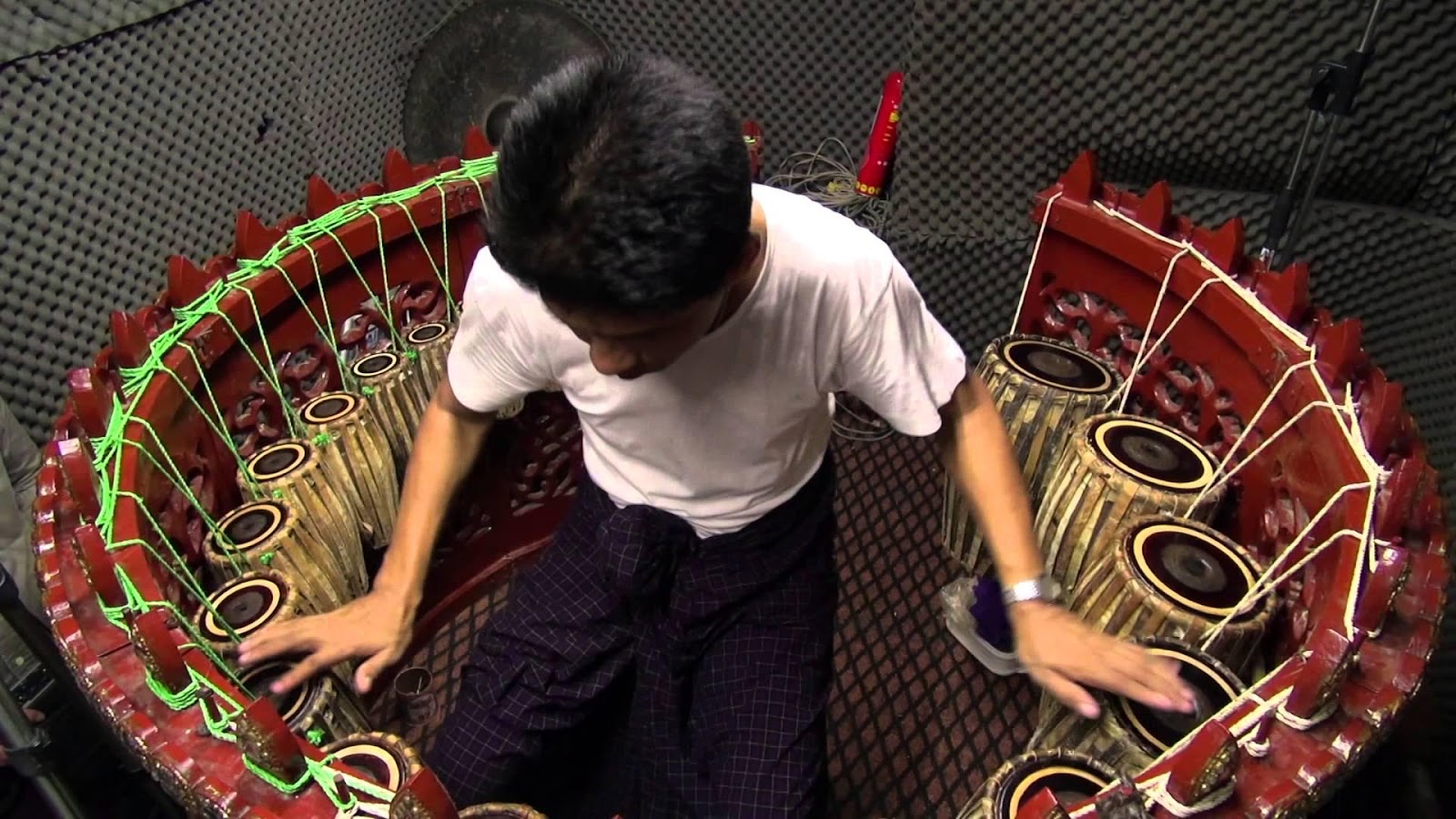
The Pat Waing is a set of 21 drums in a circle, traditional from Burma. The player sits in the middle of a horseshoe-shaped shell made of elaborately carved wood and decorated with gold leaf. The drums are played with the bare hands.
Image result for PAT WAING myanmar
KYI waing
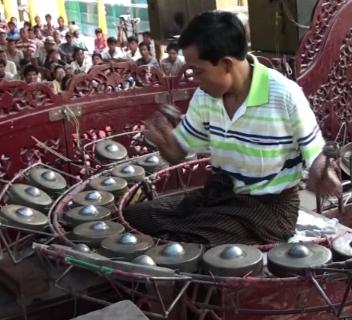
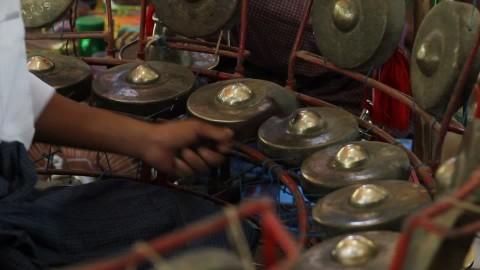
It is a set of small bronze gongs in a circular frame. This instrument is very popular in Myanmar music.
Image result for kyi waing instrument of myanmar


For more formal and classical performances that are performed indoors, the ensemble may be accompanied by the saung gauk (13-string angular harp with soft sound) the national instrument of Myanmar, the pattala (Burmese xylophone), or the piano and violin, both introduced during colonial rule.
Saung Gauk (Myanmar Harp) – the body of the saung gauk is made of padauk, the famous Myanmar mahogany. The flat bar is made of cutch wood and it is covered with the leather of a female deer. The strings are made of silk.
PATTALA (BURMESE xylophone)
Myanmar not only has musical ensembles but also an extensive collection of classical songs called the mahagita. These songs are divided into different types like the oldest repertoires, royal court music, songs of longing, horses’ dance songs, worship songs for Burmese spirits, and songs of sorrow and music adapted from Ayutthaya and the Mon people. The Saung Gauk usually accompanies these songs.
When you are having a Myanmar travel, it will be much more wonderful if you have chance to experience the beauty of Myanmar music and its rich culture.


When you have a Myanmar travel or just search some information related to this country, you may get confused about the name of the country: Myanmar or Burma. Upon landing at the country’s busiest airport, your pilot may welcome you to Yangon, but your luggage will still be tagged RGN. Though Barack Obama referred to Myanmar when he met the country’s former president, Thein Sein, for the first time, the American embassy still gives its address as “Rangoon, Burma”. And ordinary Burmese tend to refer, at least in conversation, to their country as “Burma” and its largest city as “Rangoon”. So which name should we use?

Having a Myanmar travel, most of us may be surprised to learn that in fact, Burma has pretty much always used both names. The Burmese language (like many Asian tongues) has various registers that are used in different situations, mainly to make a distinction between formal and informal situations. The names Myanma and Bama are thus both correct in Burmese – but they are used for different purposes: the former in written language; the latter in spoken. Both have been used concurrently for centuries, and are derived from the name of the largest ethnic group in Burma, the Bamar. ‘Burma’ and ‘Myanmar’ may not sound like they have the same root, but the transformation of m-sounds into b-sounds in colloquial Burmese is actually pretty common.


The military government in Burma argues that the name ‘Myanmar’ is more inclusive of ethnic minorities, but as the two names mean the same thing, critics are quick to point out that this argument doesn’t make sense. Neither ‘Burma’ nor ‘Myanmar’ is particularly inclusive toward non-Bamar ethnic minorities – of which there are a great many in Burma.
The ruling British chose Burma as the name for their colony, and after independence in 1948 it was decided that ‘Burma’ would stay. In 1989, however, the military junta took control of Burma, brutally crushing pro-democracy demonstrations and blocking the National League for Democracy. They quickly set about changing things – including the English spellings of many Burmese place names. Rangoon became Yangon, Pegu became Bago, Maymyo became Pyin Oo Lwin – and Burma became Myanmar.
When Aung San Suu Kyi stepped into office in November 2015, we were on tenterhooks to hear whether she would reiterate her rejection of the name ‘Myanmar’ or finally accept its adoption. To our surprise, she did neither. The Lady explained that everyone was free to use whichever they pleased, “because there is nothing in the constitution of our country that says that you must use any term in particular”.
Of course, we shouldn’t really have been surprised at all. President Obama used the exact same hedging tactic on his 2012 visit to Burma/Myanmar, employing both appellations interchangeably. What both Suu Kyi and Obama recognise is the importance of diplomacy. The Burmese military leaders are finally playing ball, and it would be sheer stupidity to anger them over something as trifling as a name.

It may not be the most convenient solution, but for now it is the best one that we should use when having Burma tours.


Myanmar has gradually opens its door to the outside world; therefore, it will be much easier to travel to this Golden Temple country. Myanmar has all kinds of destinations that can satisfies your hunger to explore from pristine beaches to majestic Buddha statues, they are all awaiting you. Here is a list of all things to do in Myanmar and places that you should visit when you travel to Myanmar.


Ngapali

This is a must-see place in Myanmar with palm fringed white sands and crystal clear waters. This is the perfect place to lay back and chill out for a while. Even though Ngapali beach is the most popular beach area in Myanmar, it still has a laid back fishing village vibe.

Yangon

With a population of over 6 million, it is the lagest city and the main commercial centre in Myanmar though the former military government moved the capital to Naypyidaw in 2005. Yangon is not the world’s prettiest city but what it lacks in looks it makes up in character.
You only need a few days here to visit the main sights and love wandering around the centre taking in all the sights and sounds.

Shwedagon Paya

The Shwedagon Paya is a gilded stupa bang in the centre of Yangon. It is the most sacred Buddhist site in all Myanmar and is a hive of activity every night. It is suggested that you should arrive just before sunset to take photos both in daylight and evening. There is a lovely energy about the place with locals chatting, praying, and playing.

Take a train journey

Train journey is a great way to see life in Yangon as the journey loops around surrounding satellite towns. Don’t be surprised if your carriage is full of fruit and vegetables as the train passes through many markets. Amazingly, 150,000 tickets are sold daily for the train.

Go to a tea shop

Teashops are very popular in Yangon and you should really visit once because of its wonderful experience. The shops are often very bustling and it seems like half Yangon was popping in for a cup of coffee and pastry. It is truly one of the best things to do in Myanmar.

The Golden Rock Pagoda

The Pagoda sits on the top of a giant boulder which is covered in gold leaf pasted on by Buddhist devotees. The rock sits precariously on a boulder seemingly defying gravity. Legend has it that the rock is sitting on a strand of Buddha’s hair, hence why it doesn’t fall.

chart

The jewel in Myanmar’s crown, Bagan is one of the most spectacular places in Myanmar. Bagan is an ancient city located in the Mandalay region. In its heyday there were 10,000 Buddhist temples, pagodas and monasteries built. Now there is 2,200 for you to explore. On the larger temples, you can clamber up to the top to watch sunrise or sunset. You won’t be alone but watching the sun shine over hundreds of temples below you is pretty magical no matter how many people are around you.
In general, Myanmar offers a handful places for you to explore. Let’s have your own Myanmar travel and discover the best of the country.


Choosing how to spend time in Burma can be challenging because it is such a large country – in fact it is almost three times the size of the UK. Whilst much of the country is still off limits to tourists there is still so much to see and do that you could spend two months here and not see everything.


However, we know that most of you probably have two weeks – not two months – and we can help craft the perfect itinerary to decide how best to use your time.
If you have two weeks we would recommend seeing the following highlights:
Bagan is the ancient settlement that has really put Myanmar (Burma) on the map. With more than 2,000 historic stupas, temples and pagodas spread over an enormous area, you really have to see it to believe it.
Yangon is where many start or finish their tour so it’s easy to build in a day or two. You can see the colonial architecture of a time gone by and visit the remarkable Shwedagon Pagoda, which can be seen sparkling from almost anywhere in Yangon.
Inle Lake is an impressive freshwater lake, more than 13 miles long and resembles a vast silver sheet, reflecting the sky like a mirror. Wait until you see the local fishermen who use unique fishing techniques with baskets and row with their legs!
Ngapali Beach is one of our favorite beaches in south-east Asia, a big sweeping bay with stunning boutique hotels that blend into the palms trees behind. Bliss.
Once you’ve got these staples into your tour you will have time to build in some wonderful extra destinations – you may wish to visit Mandalay in the north, which has some wonderful sites around it including the iconic U-Bein Bridge as well as being close to Hsipaw, which offers tremendous trekking. Perhaps you’d like to do some trekking in Kalaw near Inle Lake where you can also wash and feed retired elephants that have been rescued from the timber trade? Or head down south to one of our favorite areas and go kayaking through magical karst-like scenery and explore some of Myanmar’s most impressive caves.
Now is the time to visit this extraordinary land of golden spires, majestic temples and barely-touched Myanmar beaches. Expect to see wandering monks (who are the A-list celebrities here), water buffaloes grazing in beautiful scenic landscapes and a local population that still dresses traditionally, yet to be exposed to western ways.
Myanmar, or Burma as it was previously called, has only recently opened its doors to tourism after the political situation shifted in 2010. The result? A wonderfully unadulterated country with some of the friendliest people in the world who are still a little surprised to see tourists visiting their land. Of course it won’t be like this forever, but for now it might just be the last undiscovered jewel of South-East Asia.
You can spend months travelling Myanmar and have sampled everything on offer; from cruises on the Ayeyarwady River to luxurious, boutique beach hotels and basic rooms off the beaten track. Or you can watch the sunset over Bagan from the lesser-known temples, eat a freshly cooked Burmese lunch in a family home on stilts over Inle Lake and take the best of the rickety, rocking train journeys which cut through Myanmar's most scenic countryside. So come and enjoy your time in Burma.

It is necessary to learn and search information about one destination before you start your holiday. If you are going to have a trip to Myanmar, the below Myanmar websites can be a great help.


Guide Books - weather - photographs

Here are some sites related to weather and photographs.
Le guide du routard: A lot of information in French and a forum.
Lonely planet: famous guide book, a very useful forum about Myanmar in French and English.
Cycling: All the information to do cycling around the world and in Myanmar (English). Very practical.
Elsewhere magazine: Beautiful online travel magazine.
Ayeyarwady: Very nice photographs (site in English and japanese)
HS de Jong: Good pictures on Nepal and Myanmar
Peres: Travel book (in French).
Tour du monde: Travel book (in French).
Pass Planet: A very useful web site for the backpacker.
Visit-Mekong: Official web site for promoting tourism in the country around the Mekong River. A lot of link about Myanmar (in English).
World Wide gazeeter: A lot of uncommon links about Myanmar. Very interesting (English).
Tourist5: Travel guide with a lot of links for travel everywhere and in Burma.
Myanmar Opzinbest: English and Ducth website, a lot of links about Myanmar website and information (mostly links).
Geography: Map and geography of Myanmar; A lot of linls (English).
Atlapedia : Map of all the countries in the world.
Weather Undergroung : A very comprehensive web page with the weather of the main cities in Myanmar.

Buddhism, meditation (books & links)

For all information concerning the Buddhism, the practice of the meditation in Burma, or elsewhere cf. web pages: Buddhism link or, meditation Vipassana, or Meditation in Myanmar

Restaurant in Yangon

Two very good and fine places to have a diner or a drink in Yangon
Le Planteur: Leplanteur.com. Famous restaurant in Yangon, superb food and place, beautifull garden, very good wine list, the most celebrated restaurant in Yangon.
J's Bistro: half tropical garden, half upscale souvenir shop, a very beautifull place to have drink while shopping.
59, Taw Win Rd., Dagon Tsp., Yangon.
(2-minute walk from Pansea Hotel)
Tel: 951-221695, 220284 Fax: 951-228632
E-mail: irrawaddytrade@mptmail.net.mm
Internet: www.rangoonshop.com

General information (visa, transport...)

Conseils aux Voyageurs: Official French web site. A fast, lucid and objective information on the situation of all countries of the world (health, transportation, security). Very regular and alert updating from the Frecnh government on the ongoing situations.
A site regularly visited by all the main tour operators.
Website: Diplomatie.fr/Conseils travelers.
- Myanmar Embassy in Paris: Download visa form (format PDF) and information.
Website: Ambassade du Myanmar

Health

www.travelsante.com: Very convenient infos for every country with the emergencies telephones numbers. You must visit it.
www.cdc.gov/travel/: The world index web site on the ongoing epidemics and everything that can concern your health.
www.astrium.com: Everything for your journey in a tropical country; epidemics, advices, vaccinations.
Www.smi-voyage-sante.com. Very useful web site about helps and tips in Myanmar. You even have the phone number of the main clinic and doctors in Myanmar.

Pwin Oo Lwin.

The most complet web site about Pwin Oo Lwin (formely Maymyo) by Chris Harrison who wants to share with you his love for this charming city. By far the best web site about Maymyo : www.pyinoolwin.info.

Airlines

- Air Mandalay: www.air-mandalay.com
- Yangon Airways: www.yangonair.com
- Air France: www.airfrance.com
- Degriftour: www.degriftour.com
- Ebookers: www.ebookers.fr
- All airlines in the world: Directory Yahoo
- Thaï Airways: www.thaiairways.com
- Singapore Airlines: www.singaporeair.com
- Avion safety: www3.landings.com everything about air transport, security, airport, weather, database (in English)

Author Name

Biểu mẫu liên hệ

Tên

Email *

Thông báo *

Được tạo bởi Blogger.